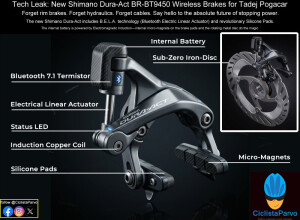








🛑🚲 Bicycle Brakes – Types, Mechanics, and Choosing the Right System
Brakes are one of the most critical safety components of any bicycle. Over time, technology has evolved from simple rim brakes to advanced hydraulic disc systems. Understanding how each brake type works, its advantages, and its limitations helps cyclists choose the right system for their riding style.
🔧 Key Brake Features
- Brake Type: Rim vs. disc (mechanical or hydraulic).
- Modulation: Ability to finely control braking force.
- Power: Maximum braking force achievable.
- Maintenance: Frequency and ease of adjustments.
- Weight: Important for racing and MTB performance.
🚴 Main Types of Bicycle Brakes
⚡ Caliper / Rim Brakes
Classic brakes where pads squeeze the wheel rim to slow or stop the bike.
- Best for: Road bikes, vintage bicycles.
- Advantages: Lightweight, simple, easy to maintain.
- Limitations: Reduced performance in wet conditions, rim wear over time.
⛰️ Cantilever Brakes
Used on cyclocross and touring bikes; the brake arms attach to posts on the frame/fork.
- Advantages: Good mud clearance, moderate stopping power.
- Limitations: Requires proper cable tension and adjustment.
🌀 V-Brakes / Linear Pull Brakes
Enhanced cantilever design, offering stronger leverage and easier maintenance.
- Best for: Mountain bikes (classic), hybrid bikes.
- Advantages: Powerful, relatively simple to maintain.
- Limitations: Still rim-based, performance affected by wet/muddy conditions.
💥 Mechanical Disc Brakes
Cable-actuated calipers squeeze brake pads on a rotor attached to the hub.
- Best for: MTB, gravel, urban bikes needing stronger stopping power.
- Advantages: More consistent braking in varied conditions, less rim wear.
- Limitations: Requires rotor alignment and occasional cable adjustments.
💧 Hydraulic Disc Brakes
Fluid-actuated braking system delivering maximum power and modulation.
- Best for: Modern MTB, road, gravel, cyclocross.
- Advantages: Excellent stopping power, smooth modulation, self-adjusting pads.
- Limitations: More complex, heavier, requires bleeding and careful maintenance.
💡 Technical Insights
- Hydraulic systems transfer force more efficiently via incompressible fluid, while mechanical systems rely on cable tension.
- Disc rotors (140–203mm) provide leverage and heat dissipation; larger rotors increase braking power.
- Brake pad material (resin vs. metallic) affects stopping power, noise, and rotor wear.
- Modulation and power are key for technical riding (MTB, descents) versus endurance road cycling.
❓ FAQ – Bicycle Brakes
Q1. What’s the difference between mechanical and hydraulic disc brakes?
Mechanical uses cables to actuate the caliper; hydraulic uses fluid for more consistent, powerful braking.
Q2. Are rim brakes obsolete?
Not entirely; they remain common on entry-level road bikes due to simplicity and low weight.
Q3. How often should hydraulic brakes be maintained?
Typically every 6–12 months, depending on use, including bleeding and pad inspection.
Q4. Can I upgrade from rim brakes to disc brakes?
Only if the frame and fork are disc-compatible; otherwise, conversion is not possible.
Learn more in our complete FAQ.
🔗 Related Articles
- Bicycle Components Explained
- Mountain Bikes (MTB)
- Road Bikes – Speed, Endurance, and Performance
- Gravel Bikes – Versatility on and off the Road
- Urban & Commuter Bikes
The Ultimate Cycling Guide: Bikes, Gear, Training & Lifestyle
- Explore our Ultimate Cycling Guide and know more about cycling in every dimension. As you navigate through the detailed guides, you’ll build knowledge and confidence, whether you’re just starting or chasing new goals on two wheels.